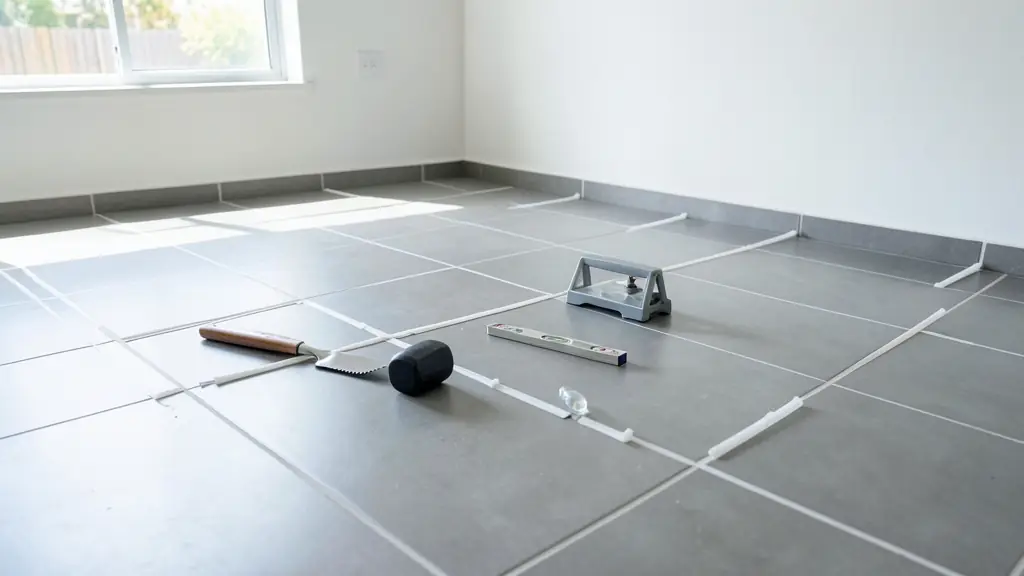
Tiling tools decide how clean the edges are, how flat the floor sits and how many tiles are lost to the bin. A good cutter, the right trowel and a set of levelling clips cost little against the price of the tiles, and trims finish the edges that grout can't. Send one request listing the tools and trims you need, or ask for hire rates for a wet saw, and tool suppliers and tile shops near you quote directly. It is free and there is no obligation.
Cutters: manual, wet saw or grinder
A manual cutter scores the glaze and snaps the tile, and it is fast and dust free for straight cuts in ceramic and thin porcelain. Look for a long bed and a tungsten wheel. A wet saw cuts with a diamond blade and a stream of water, and it is the right tool for thick porcelain, stone and mitred edges. It also keeps silica dust down. An angle grinder with a diamond blade is the cheap way to cut notches and curves, but it makes a lot of dust.
Use a continuous rim blade for a smooth porcelain edge and a segmented blade for stone and thick tiles. Diamond hole saws drill pipe and tap openings. A cutter that works on ceramic may chip porcelain, so match the tool to the tile.
Spacers, levelling clips and trowels
Spacers keep joints even: 2 to 3 mm for rectified porcelain, 3 to 5 mm for ceramic and 8 to 10 mm for rustic terracotta and stone. A levelling clip system, with a base clip and a wedge or cap, pulls neighbouring tiles flush, which matters most with large format tiles where a lipped edge shows. The clips snap off after the adhesive cures and are not reusable.
- Notched trowel: 6 mm for small tiles, 10 mm for 600 x 600, 12 mm for larger ones.
- Rubber mallet and a beating block to bed tiles without chipping them.
- Grout float, sponge and buckets for the grouting stage, plus a long spirit level or straight edge.
Trims, edges and skirting
Edge strips finish what the tile can't. Aluminium and PVC trims cover the raw edge of wall tiles at outside corners, in a range of heights from 8 mm to 12 mm. Stair nosings add grip, and transition strips join a tiled floor to carpet or vinyl at a doorway. Skirting can be tile cut to height, or a ready-made profile that is fixed with adhesive. Match the trim to the tile thickness, or the edge will stick out or sit low.
Buy or hire, and stay safe
For one bathroom, hire a wet saw by the day and buy only the consumables. If you tile every month, owning a saw is cheaper. Whichever you choose, cutting tile makes silica dust that harms lungs over time. Cut wet where you can, wear a rated dust mask and safety glasses, and add gloves and knee pads. For the adhesive that goes with the tools, see tile adhesive and grout, and see tilers if you would rather not do it yourself.
What to include in your request
- The tile type and size you are cutting
- Tools to buy and any to hire
- Trim types, heights and lengths
- How many days you will need a saw
- Your suburb and pick-up or delivery
Tiling Tools for different projects
- Homeowners renovating: a cutter, trowel and spacers for a weekend bathroom or kitchen tiling job
- New builds and extensions: bulk spacers, clips and trims for builders tiling several rooms at once
- Landlords and body corporates: a short saw hire and a few trims for a quick turnaround between tenants
- Guesthouses, hotels and restaurants: trims and nosings that finish stair edges and shower rooms neatly
- Shops, offices and showrooms: levelling clips and diamond blades for large format floors in shops
- Schools, clinics and public buildings: durable trims and cove profiles for easy-clean corners in clinics
- Workshops, warehouses and gyms: heavy-duty blades and trims for thick floor tiles and tough edges
- Patios, stoeps and pool areas: thick diamond blades and spacers for patios, stoeps and paving
Frequently asked questions
Which tile cutter should I buy for porcelain?
Do I really need levelling clips?
What size trowel do I need?
Can I hire a tile saw?
Tiling Tools by province and city
- Johannesburg
- Pretoria
- Centurion
- Midrand
- Sandton
- Randburg
- Roodepoort
- Krugersdorp
- Randfontein
- Germiston
- Boksburg
- Benoni
- Kempton Park
- Alberton
- Vanderbijlpark
- Vereeniging
- Durban
- Pinetown
- Pietermaritzburg
- Richards Bay
- Newcastle
- Ladysmith
- Gqeberha (Port Elizabeth)
- East London
- Kariega (Uitenhage)
- Mthatha
- Cape Town
- Bellville
- Paarl
- Stellenbosch
- George
- Worcester
- eMalahleni (Witbank)
- Middelburg
- Secunda
- Mbombela (Nelspruit)
- Rustenburg
- Brits
- Klerksdorp
- Potchefstroom
- Mahikeng
- Polokwane
- Tzaneen
- Kimberley
- Upington
- Bloemfontein
- Welkom
- Sasolburg