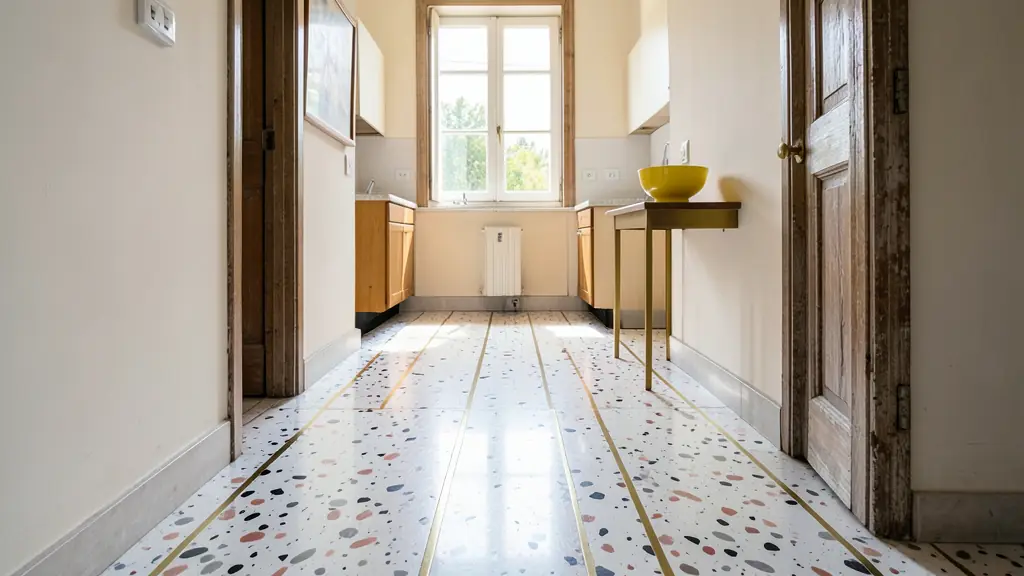
Terrazzo is a floor of marble, granite or glass chips set in cement or resin and ground smooth. You find it in older South African houses, schools, hospitals and churches, and it has come back in new kitchens and shops. It is sold as precast tiles, laid in place as one seamless floor, or imitated in porcelain. Send us the area, the colours you like and whether you are installing new or restoring old, and terrazzo specialists and tile suppliers quote you directly. The request is free and carries no obligation.
Precast tiles or poured in place
Precast terrazzo tiles are made in a factory, cured and polished, then laid like any other tile, usually 300 x 300, 400 x 400 or 600 x 600 and 16 to 25 mm thick. They are the simpler and cheaper route, and a tiler can lay them. Because they are thick, they need a strong, level base and a deep adhesive bed, and the height should be allowed for at doorways.
Poured terrazzo is mixed and laid on site, usually with brass or zinc divider strips that control cracking, then ground and polished once it has cured. It makes a seamless floor in any pattern and colour but needs a specialist team, heavy grinding machines and several days of curing. Expect a mess during the grinding, so close off the rest of the house.
Binders, chips and finish
The binder holds the chips. Cement binders are the traditional choice, hard wearing and breathable, but they need sealing and can show hairline shrinkage cracks. Resin (epoxy) binders are thinner, more flexible and available in strong colours, and they suit thin overlays and renovations where height is limited.
The chips can be marble, granite, quartz or recycled glass, in sizes from fine to chunky. A honed finish is matt and safer underfoot, while a high polish looks glossy but gets slippery when wet. Whatever the finish, ask for a penetrating sealer, because unsealed cement terrazzo absorbs oil and stains easily. Check the slip rating for any area that gets wet, and use a pH neutral cleaner, as acids dull the surface. More on that under tile cleaning and sealing.
Restoring old terrazzo floors
Many South African homes and school buildings built from the 1950s to the 1980s have terrazzo under dirty wax, old carpet or vinyl. It can often be brought back by grinding with progressively finer diamond pads, filling any cracks and chips with matching mix, then polishing and sealing. Specialists will test a patch first so you can see the result.
Before lifting old vinyl or glued floor coverings off a terrazzo floor, be cautious: coverings from before about 1990 can contain asbestos, so do not sand or break them. Get them tested and use a registered asbestos contractor if needed. Cracks that keep opening point to movement in the slab, which should be sorted out before polishing. See tile repairs for related problems.
Cost and the porcelain alternative
A rough 2026 guide is R450 to R1,500 per m² for terrazzo tiles, with poured and ground terrazzo often priced per m² for the whole job. Terrazzo-look porcelain costs less, is lighter, easier to lay and has the same speckled look, but it cannot be re-ground. Ask for the thickness, finish and whether sealing, strips and grinding are included in each quote.
What to include in your request
- New tiles, a poured floor or restoration
- The area in m² and the rooms
- Chip and cement colours you like
- Honed or high polish finish
- Photos of the floor now and your suburb
Terrazzo Tiles for different projects
- Homeowners renovating: a polished terrazzo kitchen and passage, or an old floor ground back to life
- New builds and extensions: poured terrazzo or precast tiles for feature floors, quoted from the plans
- Landlords and body corporates: restoring an existing terrazzo floor instead of recarpeting between tenants
- Guesthouses, hotels and restaurants: polished terrazzo for reception areas, restaurant floors and bar fronts
- Shops, offices and showrooms: seamless, tough terrazzo for shops, banks and showroom floors
- Schools, clinics and public buildings: restoring terrazzo floors in school corridors, clinics and church halls
- Workshops, warehouses and gyms: resin terrazzo in canteens and entrance areas that take regular trolley traffic
- Patios, stoeps and pool areas: textured terrazzo steps and covered walkways, sealed and kept non-slip
Frequently asked questions
Is terrazzo hard wearing?
Is terrazzo slippery?
Can terrazzo go over underfloor heating?
How long does a poured terrazzo floor take?
Terrazzo Tiles by province and city
- Johannesburg
- Pretoria
- Centurion
- Midrand
- Sandton
- Randburg
- Roodepoort
- Krugersdorp
- Randfontein
- Germiston
- Boksburg
- Benoni
- Kempton Park
- Alberton
- Vanderbijlpark
- Vereeniging
- Durban
- Pinetown
- Pietermaritzburg
- Richards Bay
- Newcastle
- Ladysmith
- Gqeberha (Port Elizabeth)
- East London
- Kariega (Uitenhage)
- Mthatha
- Cape Town
- Bellville
- Paarl
- Stellenbosch
- George
- Worcester
- eMalahleni (Witbank)
- Middelburg
- Secunda
- Mbombela (Nelspruit)
- Rustenburg
- Brits
- Klerksdorp
- Potchefstroom
- Mahikeng
- Polokwane
- Tzaneen
- Kimberley
- Upington
- Bloemfontein
- Welkom
- Sasolburg