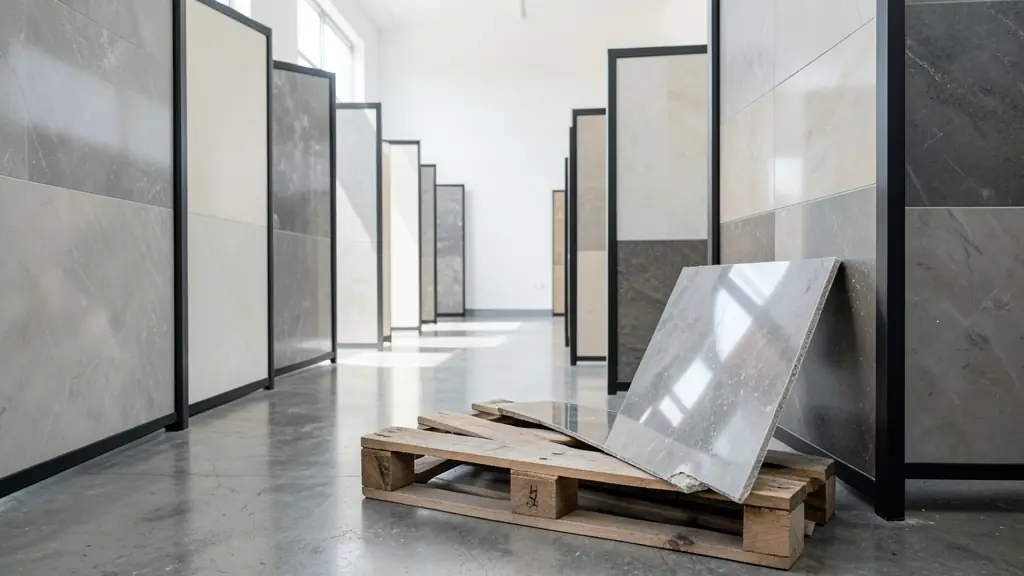
Porcelain tiles are fired at a very high temperature from fine clay, which makes them dense, hard and almost waterproof. That is why they are the first choice for busy floors, wet rooms and anything that sees sun or frost. Prices run from basic 600 x 600 tiles to large slabs that look like marble or concrete. Send one request with the area and the finish you prefer, and suppliers and tilers near you quote directly. You can ask for tiles only, laying only, or both. It is free and carries no obligation.
Glazed, full-body or double-charged
Not every porcelain tile is built the same, and the difference shows after a few years of wear. Ask the supplier which type is on offer:
- Glazed porcelain has a printed and glazed surface over a coloured body. It gives the widest range of looks, and a deep chip can show a lighter body underneath.
- Full-body porcelain carries the same colour right through, so chips and scuffs hardly show. It suits shops, schools and entrances.
- Double-charged porcelain is pressed twice, with a thick wear layer on top. It is common in polished tiles and gives a rich surface pattern.
Good porcelain absorbs under 0.5% water. That low figure is what lets it survive frost on the Highveld, which is why it is also used for outdoor tiles.
Polished, matt or lappato
A polished tile has a mirror sheen that makes a small room feel bigger, but it becomes slippery when wet and shows footprints and dust. A matt tile has a flat surface that grips better and hides marks, and it is the safer choice for kitchens, bathrooms and passages. Lappato (also called semi-polished) sits between the two: a soft shine with a little more grip.
If anyone elderly or young will walk on the floor, or if it is by a sliding door or pool, ask for the slip rating. R10 or R11 is a sensible target for wet areas. Polished tiles also need a pH-neutral cleaner, because harsh products leave a dull film.
Large format and rectified edges
Most porcelain is rectified, meaning the edges are cut square after firing. Tiles can then be laid with a joint of about 2 mm, which gives the clean, almost seamless look people want. Popular sizes are 600 x 600 for most homes and 600 x 1200 or 1200 x 1200 for open-plan rooms, where fewer joints look calmer. Tile weight and size make large slabs harder to handle, so expect a higher labour rate and ask for a levelling clip system.
Porcelain needs a flexible, polymer-modified adhesive, and large tiles need full coverage on the back and the floor. Your tiler cuts porcelain with a wet saw or a diamond blade, and drills with diamond bits. Dust from cutting contains silica, so wet cutting and a mask matter. For more on laying see tilers.
What porcelain costs
A rough 2026 guide is R150 to R750 per m² for the tiles. A basic matt 600 x 600 sits at the lower end, while large polished slabs and full-body ranges cost more. Laying adds about R160 to R380 per m², and large format sits at the top of that range. Compare quotes on the same tile size, finish and quantity, and check that the price includes adhesive, grout and delivery. The floor tile price guide has worked examples.
What to include in your request
- Area to tile in m² and the rooms
- Polished, matt or lappato, and the colour
- Tile size, rectified or not
- Tiles only, laying only, or both
- Your suburb and when you need it done
Porcelain Tiles for different projects
- Homeowners renovating: dense, easy-clean floors through the lounge, kitchen and bathrooms that last decades
- New builds and extensions: large format porcelain quoted from the plans and delivered to site in batches
- Landlords and body corporates: tough mid-range matt tiles that survive tenants and wipe clean between lets
- Guesthouses, hotels and restaurants: full-body porcelain for lobbies, restaurants and guest bathrooms with heavy use
- Shops, offices and showrooms: polished or lappato slabs for showrooms, shops and open-plan offices
- Schools, clinics and public buildings: low-absorption floors that resist cleaning chemicals in clinics and schools
- Workshops, warehouses and gyms: full-body tiles for canteens, workshops and ablutions that take knocks
- Patios, stoeps and pool areas: frost-resistant matt porcelain for patios, stoeps and covered braai areas
Frequently asked questions
What is the difference between porcelain and ceramic?
Are polished porcelain tiles too slippery?
Do I need a special tiler for 1200 x 1200 tiles?
Can porcelain go over underfloor heating?
Porcelain Tiles by province and city
- Johannesburg
- Pretoria
- Centurion
- Midrand
- Sandton
- Randburg
- Roodepoort
- Krugersdorp
- Randfontein
- Germiston
- Boksburg
- Benoni
- Kempton Park
- Alberton
- Vanderbijlpark
- Vereeniging
- Durban
- Pinetown
- Pietermaritzburg
- Richards Bay
- Newcastle
- Ladysmith
- Gqeberha (Port Elizabeth)
- East London
- Kariega (Uitenhage)
- Mthatha
- Cape Town
- Bellville
- Paarl
- Stellenbosch
- George
- Worcester
- eMalahleni (Witbank)
- Middelburg
- Secunda
- Mbombela (Nelspruit)
- Rustenburg
- Brits
- Klerksdorp
- Potchefstroom
- Mahikeng
- Polokwane
- Tzaneen
- Kimberley
- Upington
- Bloemfontein
- Welkom
- Sasolburg