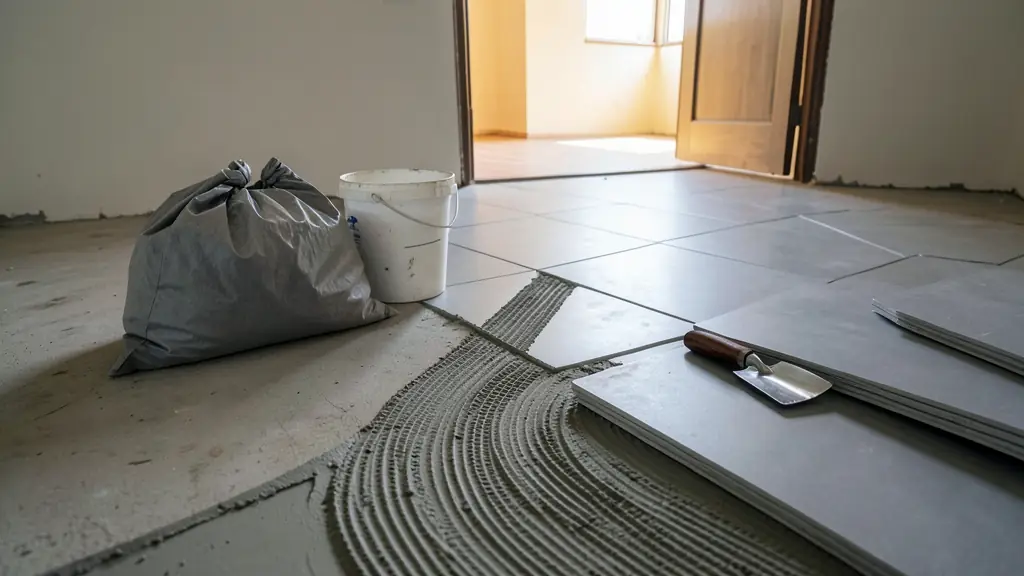
Tile adhesive and grout hold a floor together, and a cheap bag on a good tile is the most common reason a floor fails. Adhesive is sold by the 20 kg bag and grout by the 5 kg or 20 kg bag, and the right grade depends on the tile, the size and the surface under it. Send one request with the area, the tile type and size and the base, and suppliers and tilers near you quote the right products, delivered if needed. It is free and there is no obligation.
Choosing the adhesive: C1, C2 and S1
Cementitious tile adhesives are graded by a standard code. C1 is a normal grade that suits small ceramic tiles on a dry, sound screed. C2 has higher bond strength and is the one for porcelain, floors with heavy traffic, outdoor areas and wet rooms. A suffix adds more: S1 is a flexible adhesive that tolerates movement, and it is the right choice over underfloor heating, on a timber floor, outside in strong sun and for large format tiles.
Dense porcelain absorbs almost no water, so it cannot key into a weak adhesive. Use a C2 or C2S1 grade for it. Where the surface is smooth, dusty or very absorbent, a bonding liquid or primer is applied first. Always mix to the maker's water ratio and use the adhesive within its open time.
How much adhesive to order
Coverage depends on the trowel notch, and it is lower than most buyers expect. As a rough guide a 20 kg bag spreads over:
- 6 mm notch (tiles up to about 300 x 300): 4 to 5 m².
- 10 mm notch (600 x 600 tiles): 3 to 4 m².
- 12 mm notch and back-buttering (600 x 1200 and larger): 2 to 3 m².
An uneven screed uses more. Add 10% for waste and buy a spare bag, since a shortage mid-floor means a visible change of batch. The quote form on this page works out the bags from the area and the tile size.
Grout: sanded, unsanded or epoxy
Unsanded grout suits joints under 3 mm, such as rectified porcelain and wall tiles. Sanded grout resists shrinking in wider joints, from 3 mm to 10 mm, and it is the usual floor grout. Epoxy grout is a two-part resin that does not stain or absorb water, so it is used in showers, kitchens, commercial kitchens and around pools. It is harder to work with and costs several times more, so it pays to use a trained tiler.
Choose the colour carefully. A grout one shade darker than the tile hides dirt, and a strong contrast makes the pattern stand out. Test a small patch and let it dry, because the colour lightens as it cures. Use flexible silicone, not grout, in internal corners and where floor meets wall, so the room can move. See tile cleaning and sealing to look after the grout lines.
Pricing and matching it to the job
A rough 2026 guide is R90 to R450 per bag, with basic C1 bags at the bottom and flexible C2S1 or epoxy kits at the top. Ask the supplier to match the adhesive to your tile and base, rather than choosing on price alone. Quotes should show the grade, the bag weight and the delivery cost. See the porcelain tiles page for how dense tiles change the choice.
What to include in your request
- Area to tile in m² and the tile size
- Tile type: porcelain, ceramic or stone
- Floor or wall, inside or outside
- The base: screed, board or old tiles
- Grout colour wanted and your suburb
Tile Adhesive and Grout for different projects
- Homeowners renovating: the right adhesive and grout for a bathroom, kitchen or floor, bought by the bag
- New builds and extensions: adhesive and grout ordered by the pallet for the whole house and delivered to site
- Landlords and body corporates: reliable mid-grade adhesive and stain-hiding grout for quick turnarounds between tenants
- Guesthouses, hotels and restaurants: epoxy grout in kitchens and shower rooms, and flexible adhesive under big tiles
- Shops, offices and showrooms: fast-setting flexible adhesive for large format floors laid after hours
- Schools, clinics and public buildings: easy-clean grout and strong adhesive for clinics, ablutions and school floors
- Workshops, warehouses and gyms: high-strength C2 adhesive and epoxy grout for floors under heavy trolleys
- Patios, stoeps and pool areas: flexible, frost-tolerant adhesive and sanded grout for patios, stoeps and pool surrounds
Frequently asked questions
How many bags of tile adhesive do I need?
Can I use normal tiling cement for porcelain?
What does bonding liquid do?
How long before I can grout?
Tile Adhesive and Grout by province and city
- Johannesburg
- Pretoria
- Centurion
- Midrand
- Sandton
- Randburg
- Roodepoort
- Krugersdorp
- Randfontein
- Germiston
- Boksburg
- Benoni
- Kempton Park
- Alberton
- Vanderbijlpark
- Vereeniging
- Durban
- Pinetown
- Pietermaritzburg
- Richards Bay
- Newcastle
- Ladysmith
- Gqeberha (Port Elizabeth)
- East London
- Kariega (Uitenhage)
- Mthatha
- Cape Town
- Bellville
- Paarl
- Stellenbosch
- George
- Worcester
- eMalahleni (Witbank)
- Middelburg
- Secunda
- Mbombela (Nelspruit)
- Rustenburg
- Brits
- Klerksdorp
- Potchefstroom
- Mahikeng
- Polokwane
- Tzaneen
- Kimberley
- Upington
- Bloemfontein
- Welkom
- Sasolburg